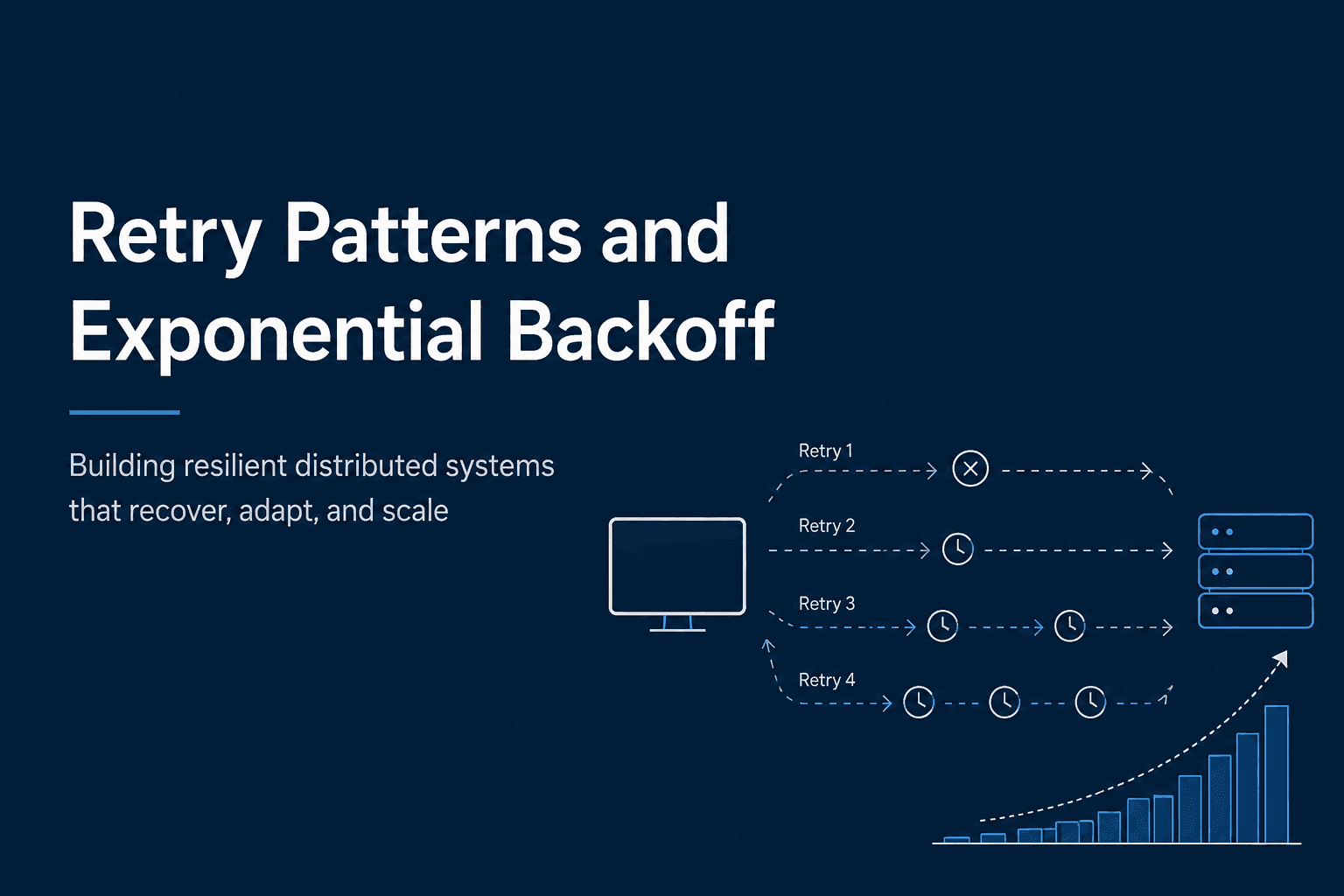

Retry patterns and exponential backoff are crucial strategies for handling transient errors in distributed systems, allowing clients to recover from temporary failures without overwhelming the system. By incorporating exponential backoff and jitter, these patterns prevent thundering herds and reduce the likelihood of cascading failures. Effective implementation of retry patterns requires a deep understanding of the underlying system architecture, trade-offs, and distributed systems principles.
Background
The concept of retry patterns dates back to the early days of distributed systems, where network timeouts and temporary overloads were common. As systems grew in complexity, the need for robust retry mechanisms became increasingly important. Exponential backoff, in particular, has emerged as a widely adopted strategy for handling transient errors, as it allows clients to back off and retry at increasingly longer intervals, reducing the load on the system.
Core Concepts
Fundamentals of Retry Patterns
Retry patterns are based on the idea of repeating a failed operation in the hopes of succeeding on a subsequent attempt. Key concepts include:
- Transient errors: errors that are temporary and likely to resolve themselves
- Permanent errors: errors that are unlikely to resolve themselves
- Idempotence: the ability of an operation to be repeated without changing the outcome
Exponential Backoff
Exponential backoff involves increasing the delay between retries, typically using a base delay and a backoff factor. This approach helps to prevent thundering herds and reduce the load on the system.
Architecture Deep Dive
A well-designed retry pattern should take into account the system architecture and distributed systems principles. This includes considering factors such as network latency, server load, and client behavior. Trade-offs must be made between aggressiveness and conservatism, as well as between latency and throughput. A feedback loop can be used to monitor and adjust the retry pattern in real-time.
How It Works
Operation of Retry Patterns
When a client encounters a transient error, it will retry the operation after a short delay. If the retry fails, the client will back off and retry again after a longer delay. This process continues until the operation succeeds or a maximum number of retries is reached. Jitter can be added to the delay to prevent synchronization and reduce the likelihood of thundering herds.
Implementation Guide
Implementing a retry pattern with exponential backoff requires careful consideration of the system architecture and trade-offs. A programming language with built-in support for async/await and retry libraries can simplify the implementation process.
Example Retry Pattern in Python
This example demonstrates a basic retry pattern with exponential backoff and jitter. The retry_operation function takes in max_retries, base_delay, and backoff_factor as parameters and performs the operation with retries.
Performance and Scalability
Retry patterns with exponential backoff can have a significant impact on system performance and scalability. Aggressive retry patterns can lead to increased latency and reduced throughput, while conservative retry patterns can result in decreased latency and increased throughput. Trade-offs must be made between these competing factors to achieve optimal system performance.
Security and Reliability
Retry patterns with exponential backoff can also have implications for system security and reliability. Insecure retry patterns can lead to denial-of-service attacks, while unreliable retry patterns can result in data corruption or loss. Secure and reliable retry patterns must be designed with these considerations in mind.
Common Pitfalls
Common pitfalls when implementing retry patterns with exponential backoff include:
- Insufficient jitter, leading to thundering herds
- Inadequate monitoring, resulting in unnoticed failures
- Inconsistent retry policies, causing inconsistent behavior
- Inadequate testing, leading to unforeseen consequences
Real-World Use Cases
Retry patterns with exponential backoff are used in a variety of real-world applications, including:
- Cloud services, such as AWS and Azure
- Distributed databases, such as Cassandra and MongoDB
- Microservices architectures, such as Netflix and Uber
- IoT devices, such as smart home appliances and industrial sensors
Future Trends
Emerging trends in retry patterns with exponential backoff include:
- Machine learning-based retry policies, which can adapt to changing system conditions
- Autonomous retry systems, which can self-heal and self-configure
- Edge computing, which can reduce latency and improve reliability
Key Takeaways
- Retry patterns with exponential backoff are crucial for handling transient errors in distributed systems
- Exponential backoff and jitter are essential components of a robust retry pattern
- System architecture and trade-offs must be carefully considered when designing a retry pattern
- Implementation requires careful consideration of performance, security, and reliability
- Emerging trends include machine learning-based retry policies and autonomous retry systems