
PACELC Theorem: Understanding the Trade-Offs Beyond CAP
Distributed systems are built around trade-offs. While the CAP theorem explains what happens during network partitions, it says little about the decisions systems make during normal operation.
The PACELC theorem, proposed by computer scientist Daniel J. Abadi, extends CAP by recognizing that distributed systems face trade-offs even when no partition exists. Specifically, systems must often choose between consistency and latency.
This makes PACELC a more practical framework for understanding the design of modern distributed databases, cloud platforms, and globally distributed applications.
Why CAP Is Not Enough
The CAP theorem states that during a network partition, a distributed system can provide at most two of the following:
| Property | Description |
|---|---|
| Consistency (C) | Every read receives the most recent write. |
| Availability (A) | Every request receives a response. |
| Partition Tolerance (P) | The system continues operating despite network failures. |
The limitation of CAP is that partitions are relatively rare events, while systems spend most of their lifetime operating normally.
PACELC addresses this gap.
What PACELC Means
PACELC stands for:
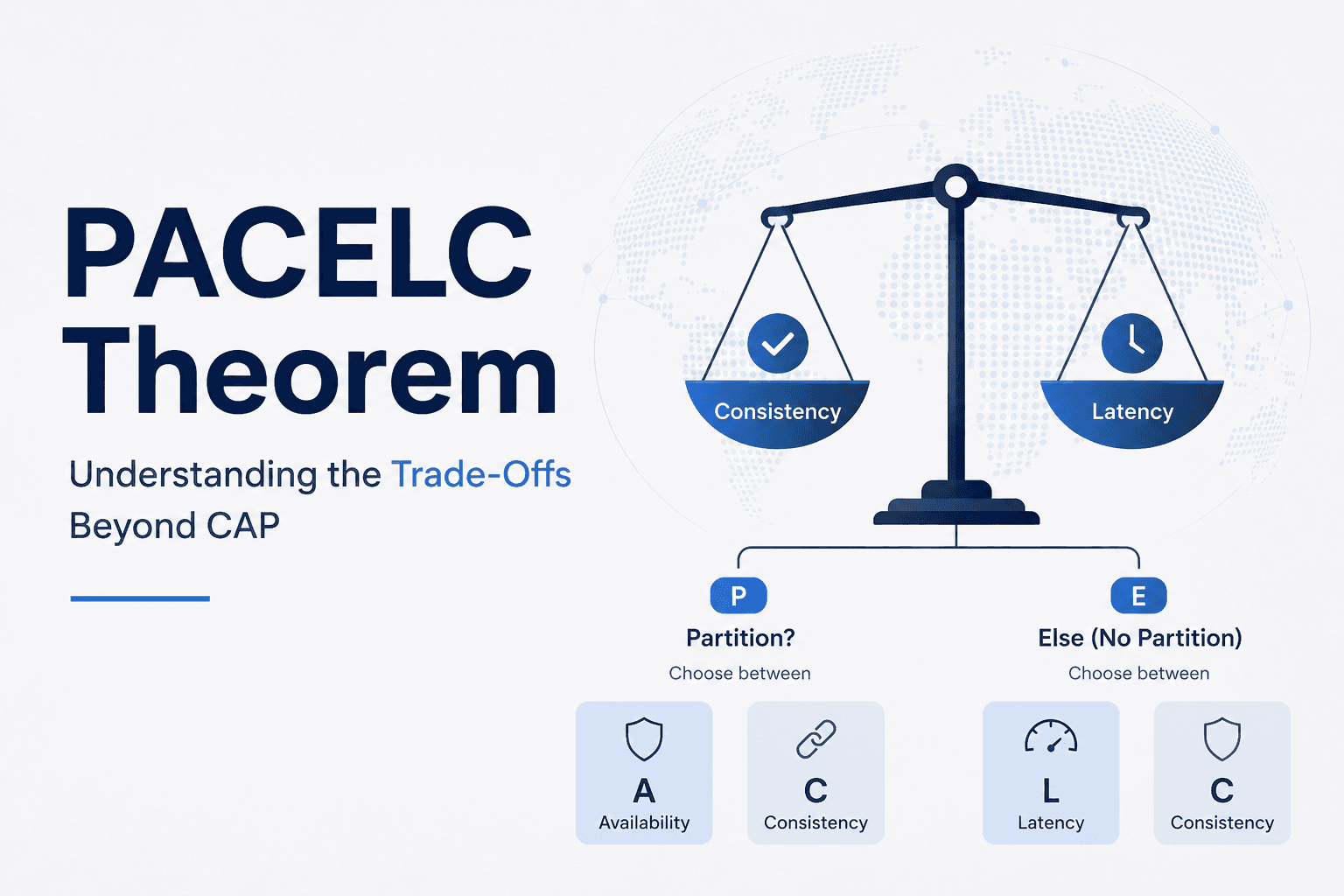
If there is a Partition (P), choose between Availability (A) and Consistency (C); Else (E), choose between Latency (L) and Consistency (C).
PACELC Decision Flow
The Two Trade-Offs
During a Partition (PA vs PC)
When communication between nodes fails:
| Choice | Result |
|---|---|
| PA | System remains available but may return stale data. |
| PC | System maintains consistency but may reject requests. |
Example: Availability First
A social media platform may continue serving content even if some replicas contain outdated data.
Example: Consistency First
A banking system may temporarily block transactions rather than risk inconsistent account balances.
During Normal Operation (EL vs EC)
Even without failures, replicas must coordinate to maintain consistency.
| Choice | Result |
|---|---|
| EL | Lower latency, potentially weaker consistency. |
| EC | Strong consistency, higher response times. |
This trade-off exists because synchronization between geographically distributed replicas introduces network delays.
PACELC Classification of Popular Systems
| System | PACELC Classification | Characteristics |
|---|---|---|
| Amazon DynamoDB | PA/EL | Prioritizes availability and low latency. |
| Apache Cassandra | PA/EL | Eventual consistency with fast responses. |
| Riak | PA/EL | Designed for availability during failures. |
| Google Spanner | PC/EC | Strong consistency using global coordination. |
| CockroachDB | PC/EC | Distributed SQL with strong consistency. |
| HBase | PC/EC | Consistency-oriented architecture. |
Note: Many modern databases allow configuration of consistency levels, meaning their practical behavior can vary by deployment.
Why Latency and Consistency Conflict
Consider a write operation replicated across multiple regions:
To guarantee strong consistency, the primary node may need acknowledgements from multiple replicas before confirming success.
This coordination improves correctness but increases response time.
A low-latency system may instead acknowledge the write immediately and replicate asynchronously, accepting temporary inconsistencies.
Real-World Examples
E-Commerce Platforms
Product catalogs and recommendations often prioritize availability and latency.
A user seeing a slightly outdated inventory count is usually acceptable.
Financial Systems
Payment processing and banking applications prioritize consistency.
Incorrect balances or duplicate transactions are unacceptable, even if latency increases.
Streaming Services
Services such as video streaming platforms typically favor availability and low latency.
A delayed update to viewing statistics is less important than uninterrupted playback.
Design Implications
When designing distributed systems, architects should evaluate:
| Requirement | Preferred Approach |
|---|---|
| Financial correctness | Consistency-first |
| Real-time user experience | Latency-first |
| Global scalability | Often availability-first |
| Mission-critical transactions | Strong consistency |
| Analytics and reporting | Eventual consistency may be acceptable |
The correct choice depends on business requirements rather than technical preference.
Common Misconceptions
"Strong Consistency Is Always Better"
Not necessarily.
Many applications can tolerate temporary inconsistencies while benefiting significantly from lower latency and higher availability.
"CAP and PACELC Compete"
PACELC does not replace CAP.
It extends CAP by describing system behavior both during and outside network partitions.
"Eventual Consistency Means Incorrect Data"
Eventual consistency guarantees that replicas will converge over time. The inconsistency is temporary, not permanent.
Key Takeaways
- PACELC extends the CAP theorem by addressing trade-offs during normal operation.
- During a partition, systems choose between availability and consistency.
- Without a partition, systems choose between latency and consistency.
- Strong consistency typically requires coordination between replicas, increasing latency.
- Eventual consistency enables faster responses but may return stale data temporarily.
- Modern distributed databases often expose configuration options that allow developers to tune these trade-offs based on application requirements.
Conclusion
The PACELC theorem provides a more realistic model for understanding modern distributed systems than CAP alone. While CAP focuses on rare failure scenarios, PACELC highlights the everyday trade-offs architects face between consistency and latency.
Whether designing a globally distributed database, a financial platform, or a large-scale cloud application, understanding PACELC helps engineers make informed decisions about performance, reliability, and correctness.