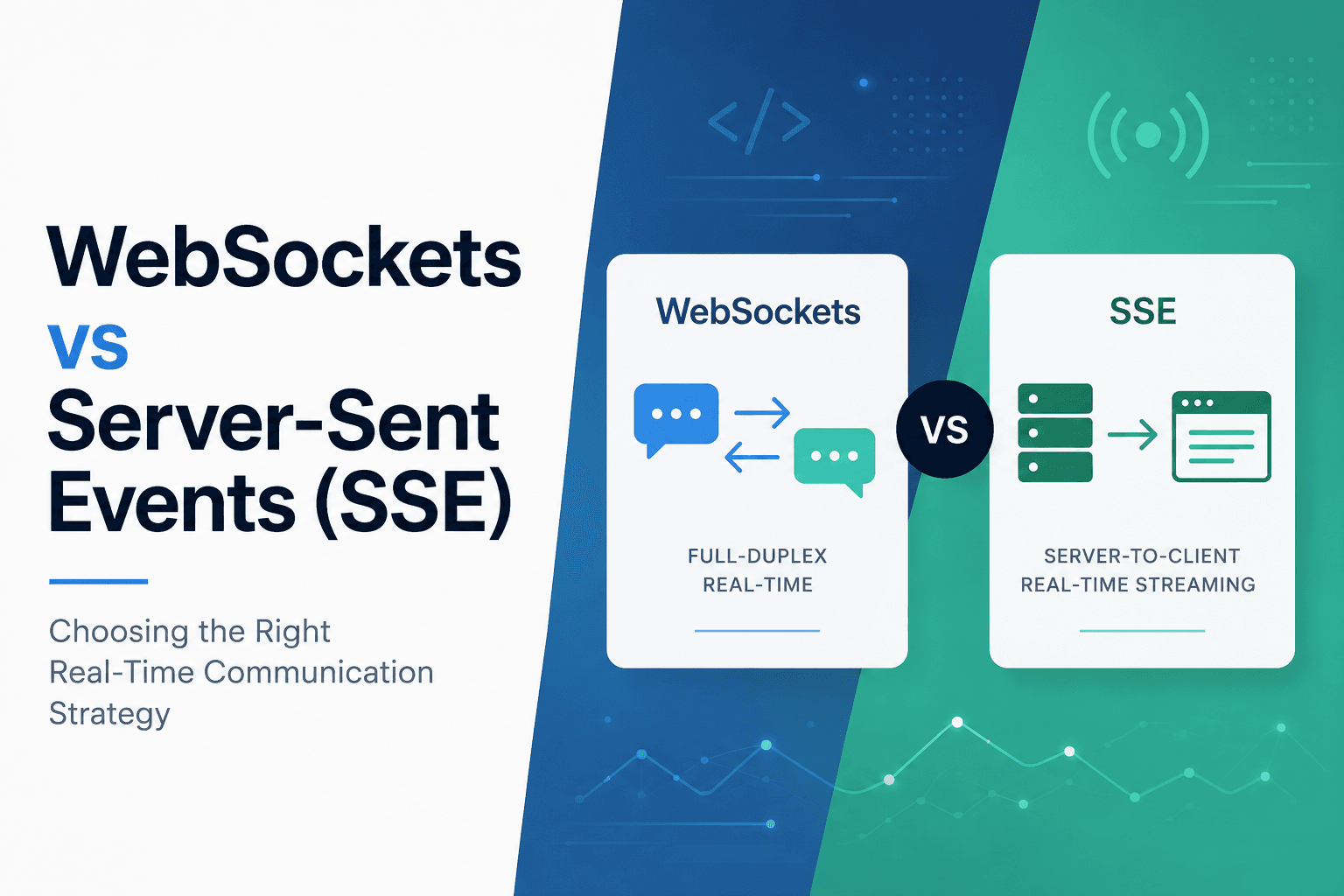

WebSockets vs Server-Sent Events (SSE): Choosing the Right Real-Time Communication Strategy
Modern web applications increasingly depend on real-time communication. Whether it's collaborative document editing, stock market dashboards, multiplayer games, notification systems, or live analytics, users expect information to update instantly without refreshing the page.
Traditional HTTP follows a request-response model where the client must initiate every interaction. While suitable for many applications, this model becomes inefficient when updates need to be delivered immediately.
To solve this problem, two major technologies emerged:
- WebSockets for full-duplex communication
- Server-Sent Events (SSE) for server-to-client streaming
Although both enable real-time experiences, they solve different problems and come with distinct architectural trade-offs.
Why Traditional HTTP Falls Short
In a traditional workflow:
The server cannot push updates independently.
Applications requiring live updates often relied on:
- Short polling
- Long polling
- Frequent AJAX requests
These approaches waste bandwidth, increase latency, and place unnecessary load on servers.
Real-time communication protocols address these limitations by maintaining persistent connections.
Understanding WebSockets
WebSockets provide a persistent, low-latency, full-duplex communication channel between client and server.
Once established, both sides can send data at any time without additional HTTP requests.
WebSocket Lifecycle
Connection Flow
- Client initiates an HTTP Upgrade request.
- Server accepts the upgrade.
- Protocol switches from HTTP to WebSocket.
- Persistent TCP connection remains open.
- Both sides exchange messages freely.
Example
Understanding Server-Sent Events (SSE)
Server-Sent Events provide a persistent HTTP connection that allows the server to continuously stream updates to clients.
Unlike WebSockets, communication is strictly one-way:
Clients cannot send messages through the SSE connection itself.
SSE Lifecycle
Example
Architecture Comparison
WebSocket Architecture
Bidirectional communication allows:
- Chat systems
- Multiplayer games
- Collaborative editing
- Interactive dashboards
SSE Architecture
Ideal for:
- Notifications
- Live feeds
- Monitoring dashboards
- Stock prices
Feature Comparison
| Feature | WebSockets | SSE |
|---|---|---|
| Communication | Bidirectional | Server → Client |
| Protocol | WebSocket | HTTP |
| Connection Type | Persistent TCP | Persistent HTTP |
| Browser Support | Excellent | Excellent |
| Binary Data | Supported | Not Supported |
| Automatic Reconnection | Manual | Built-in |
| Firewall Compatibility | Sometimes problematic | Excellent |
| Complexity | Higher | Lower |
| Latency |
Performance Characteristics
| Metric | WebSockets | SSE |
|---|---|---|
| Connection Overhead | Initial handshake | Standard HTTP |
| Memory Usage | Higher | Lower |
| Network Efficiency | Excellent | Good |
| Message Frequency | Very High | Moderate |
| Scalability | More complex | Easier |
| Infrastructure Compatibility | Requires support | Works with existing HTTP infrastructure |
Scalability Considerations
Persistent connections introduce unique scaling challenges.
WebSocket Scaling
Common challenges:
- Sticky sessions
- Connection state management
- Distributed message delivery
- Horizontal scaling
Often solved using:
- Redis Pub/Sub
- Kafka
- NATS
- RabbitMQ
SSE Scaling
SSE leverages standard HTTP infrastructure.
Benefits include:
- Easier load balancing
- Simpler deployment
- Better compatibility with CDNs and proxies
However, thousands of open connections still consume server resources.
Reliability Features
WebSockets
Developers typically implement:
- Heartbeats
- Ping/Pong messages
- Reconnection logic
- Connection state recovery
Example:
SSE
SSE includes automatic reconnection.
If the connection drops:
This significantly reduces client-side complexity.
Security Considerations
Both technologies should always use TLS:
Recommended Security Practices
| Practice | WebSockets | SSE |
|---|---|---|
| TLS Encryption | Required | Required |
| Authentication | JWT/Cookies | JWT/Cookies |
| Authorization Checks | Required | Required |
| Rate Limiting | Recommended | Recommended |
| Input Validation | Required | Required |
Common threats:
- Connection flooding
- Message spam
- Unauthorized subscriptions
- Session hijacking
Common Pitfalls
WebSocket Pitfalls
Ignoring Disconnects
Networks fail constantly.
Applications must handle:
- Wi-Fi drops
- Browser refreshes
- Mobile network changes
Storing Excessive Connection State
Large connection maps can consume significant memory.
Missing Heartbeat Mechanisms
Without health checks, dead connections accumulate.
SSE Pitfalls
Attempting Bidirectional Communication
SSE only supports server-to-client updates.
Client actions still require:
through regular HTTP requests.
Large Event Payloads
Streaming huge payloads can degrade performance.
Prefer incremental updates.
Real-World Use Cases
When WebSockets Are the Right Choice
| Application | Reason |
|---|---|
| Multiplayer Games | Bidirectional updates |
| Chat Applications | Instant messaging |
| Collaborative Editors | Real-time synchronization |
| Remote Control Systems | Continuous interaction |
| Trading Platforms | Low-latency communication |
When SSE Is the Right Choice
| Application | Reason |
|---|---|
| Notification Systems | One-way updates |
| News Feeds | Continuous stream |
| Live Sports Scores | Server pushes updates |
| Monitoring Dashboards | Metrics streaming |
| Stock Tickers | Real-time broadcasts |
Decision Matrix
Future of Real-Time Communication
Several technologies continue to evolve alongside WebSockets and SSE:
- WebRTC for peer-to-peer communication
- HTTP/3 and QUIC
- Edge computing platforms
- Distributed event streaming systems
- Real-time AI applications
Despite newer protocols emerging, WebSockets and SSE remain the dominant solutions for browser-based real-time communication.
Key Takeaways
| Question | Recommendation |
|---|---|
| Need bidirectional communication? | WebSockets |
| Need notifications or streaming updates? | SSE |
| Want simplest implementation? | SSE |
| Need lowest possible latency? | WebSockets |
| Need binary data transfer? | WebSockets |
| Need automatic reconnection? | SSE |
In practice, neither technology is universally better.
Choose WebSockets when clients and servers must continuously communicate in both directions. Choose SSE when the server primarily pushes updates to clients and simplicity is more important than bidirectional communication.
The best architecture is rarely the most powerful one. It's the one that solves the problem with the least complexity. Humanity keeps rediscovering this lesson every few years, usually after building something magnificently overengineered.