
Background
Introduction to Dead Letter Queues
Dead letter queues (DLQs) are a critical component in distributed systems, providing a safety net for messages that cannot be processed successfully. When a consumer fails to process a message, the message is moved to a separate queue for inspection, debugging, or replay.
This mechanism prevents poison messages from blocking the primary queue and improves overall system resilience and reliability. Dead letter queues are now a standard pattern in modern event-driven and message-oriented architectures.
History and Evolution
The concept of dead letter queues originated in early messaging systems where operators needed a reliable way to isolate failed or malformed messages.
Over time, DLQ implementations evolved to support:
- Message expiration
- Retry policies
- Delayed retries
- Alerting and monitoring
- Replay workflows
- Automated remediation pipelines
These additions transformed dead letter queues from simple failure storage into an operational reliability tool.
Core Concepts
- Message: A unit of data exchanged between distributed components.
- Producer: A service or application that publishes messages.
- Consumer: A service that processes messages from a queue or topic.
- Poison Message: A message that repeatedly fails processing.
- Retry Mechanism: Logic that attempts message processing again after failure.
- Dead Letter Queue (DLQ): A dedicated queue used to isolate failed messages.
Dead Letter Queue Components
- Main Queue: Receives normal application traffic.
- Dead Letter Queue: Stores failed or unprocessable messages.
- Message Router: Redirects failed messages to the DLQ.
- Retry Processor: Handles retry attempts and backoff strategies.
- Monitoring System: Tracks failures, retries, and queue growth.
Architecture Deep Dive
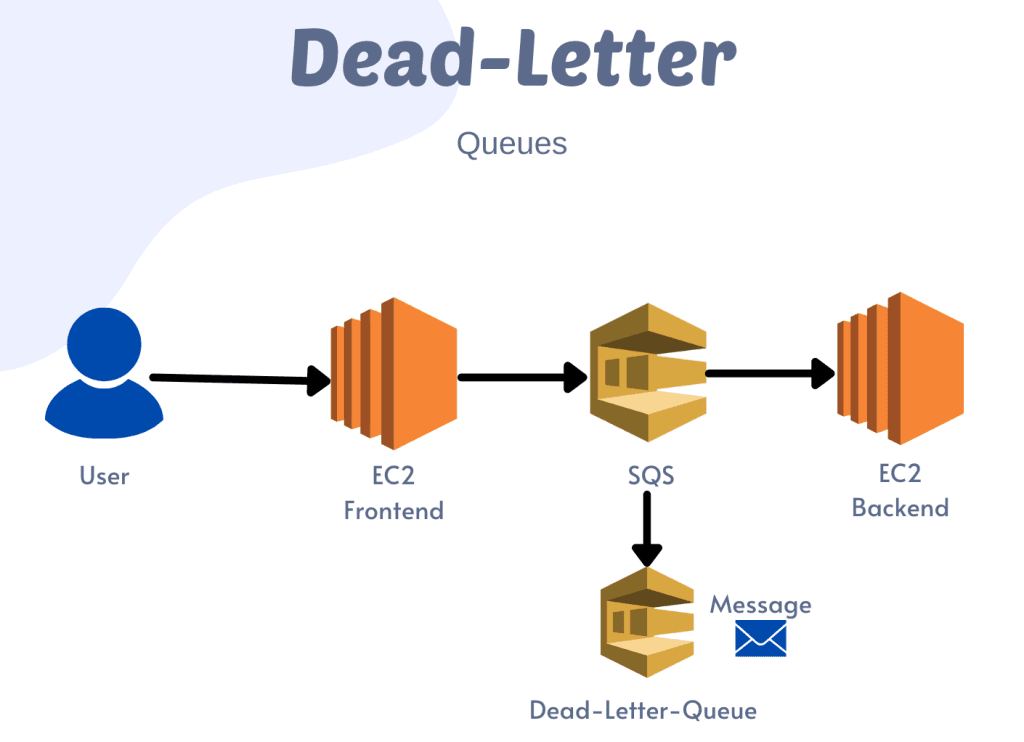
A typical DLQ architecture contains:
- A primary processing queue
- One or more consumers
- Retry logic
- A dead letter queue for failed messages
- Operational tooling for inspection and replay
The flow generally looks like this:
- Producers publish messages to the main queue.
- Consumers process messages.
- Failed messages are retried according to policy.
- Messages exceeding retry thresholds are moved to the DLQ.
- Operators or automated systems inspect and remediate failures.
Distributed Systems Considerations
Designing DLQs in distributed systems introduces several trade-offs:
- Scalability: Supporting high-throughput workloads without bottlenecks.
- Availability: Ensuring failed messages remain accessible during outages.
- Partition Tolerance: Handling network failures gracefully.
- Ordering Guarantees: Preserving event ordering when retries occur.
- Idempotency: Preventing duplicate side effects during retries.
CAP Theorem Trade-Offs
Dead letter queue systems must balance:
- Consistency
- Availability
- Partition Tolerance
For example, prioritizing availability may temporarily allow inconsistent retry states, while prioritizing consistency can increase latency during partitions.
How It Works
Message Flow
- A producer publishes a message to the main queue.
- A consumer retrieves and processes the message.
- If processing succeeds, the message is acknowledged.
- If processing fails, retry logic is triggered.
- After exceeding retry limits, the message is moved to the dead letter queue.
- The failed message can later be inspected, replayed, or discarded.
Retry Strategies
Common retry strategies include:
- Exponential Backoff: Retry intervals increase exponentially after each failure.
- Linear Backoff: Retry intervals increase at a fixed rate.
- Jittered Retries: Randomized retry delays reduce retry storms.
- Circuit Breakers: Temporarily stop retries during downstream outages.
Implementation Guide
Implementing a DLQ requires careful planning around retries, observability, and operational workflows.
High-Level Implementation Steps
- Choose a messaging platform such as Apache Kafka, RabbitMQ, or AWS SQS.
- Configure retry policies and maximum retry counts.
- Create a dead letter queue or topic.
- Route failed messages automatically after retry exhaustion.
- Implement monitoring and alerting.
- Build replay or remediation tooling.
Example: Apache Kafka Dead Letter Queue
This example demonstrates a simple DLQ setup in Apache Kafka using Java. Failed messages are redirected to a dedicated dead letter topic for later analysis.
Performance and Scalability
Dead letter queues can become operational bottlenecks if not designed carefully.
Key considerations include:
- Message Throughput: Sustaining high ingestion and retry rates.
- Processing Latency: Minimizing retry delays and queue contention.
- Queue Growth: Preventing unbounded accumulation of failed messages.
- Storage Costs: Managing long-term retention of failed events.
- Backpressure Handling: Preventing retries from overwhelming downstream systems.
Scalability Strategies
To scale DLQ systems effectively:
- Use horizontal partitioning or sharding.
- Deploy distributed brokers and consumers.
- Use load balancing across processing nodes.
- Separate retry traffic from primary traffic.
- Implement asynchronous replay pipelines.
Security and Reliability
Dead letter queues often contain sensitive or malformed data, making security essential.
Security Considerations
- Authentication: Verify producer and consumer identities.
- Authorization: Restrict access to DLQ inspection and replay tools.
- Encryption: Encrypt messages both in transit and at rest.
- Audit Logging: Record replay and deletion operations.
Reliability Considerations
Reliable DLQ systems should support:
- Fault-tolerant storage
- Replication across nodes
- High availability configurations
- Durable message persistence
- Safe replay mechanisms
- Disaster recovery procedures
Common Pitfalls
- Infinite Retry Loops: Reprocessing permanently invalid messages endlessly.
- Missing Monitoring: Failing to detect DLQ growth or replay failures.
- Lack of Replay Tooling: Making remediation manual and error-prone.
- Ignoring Idempotency: Creating duplicate side effects during retries.
- Overloaded DLQs: Treating DLQs as permanent storage instead of temporary isolation.
Real-World Use Cases
Dead letter queues are widely used in:
- Event Processing Systems: Isolating malformed or failed events.
- Job Processing Pipelines: Handling failed background jobs.
- Payment Systems: Capturing failed transactions safely.
- Microservices Architectures: Preventing cascading failures.
- Data Pipelines: Storing records that fail validation or transformation.
Future Trends
Emerging trends in DLQ systems include:
- Cloud-Native DLQs: Deep integration with managed messaging platforms.
- Automated Recovery Pipelines: AI-assisted remediation and replay.
- Serverless Event Handling: DLQs integrated with event-driven compute platforms.
- Advanced Observability: Real-time tracing and anomaly detection for failed messages.
- Policy-Driven Retries: Adaptive retry strategies based on error classification.
Key Takeaways
- Dead letter queues improve resilience by isolating failed messages.
- Retry policies and replay tooling are essential parts of DLQ design.
- Distributed systems require careful handling of consistency, scalability, and fault tolerance.
- Monitoring and observability are critical for operational reliability.
- DLQs should be treated as temporary remediation systems, not permanent storage.
- Modern architectures increasingly rely on automated and cloud-native DLQ workflows.