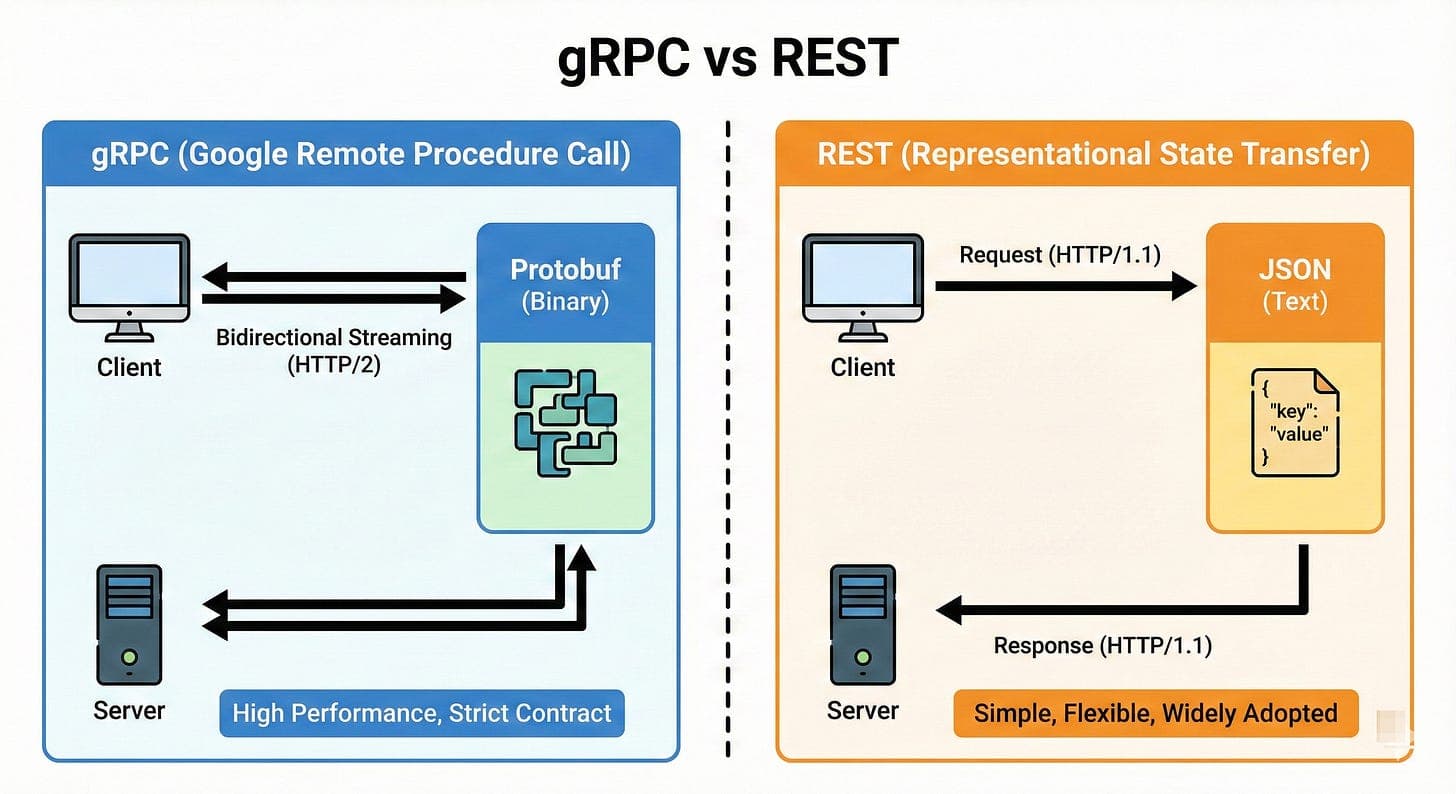

gRPC vs REST
The choice between gRPC and REST depends on the specific requirements of a project.
- REST is suitable for public APIs where readability and compatibility are crucial.
- gRPC is preferred for service-to-service communication in microservices architectures where performance and strong contracts are essential.
gRPC's use of HTTP/2 and binary-encoded messages provides a significant performance boost, while REST's simplicity and human-readable JSON make it a popular choice for external clients.
Background
The history of API design dates back to the early days of the web, with REST emerging as a dominant paradigm due to its simplicity and flexibility.
As system complexity increased, the need for more efficient and scalable solutions arose, leading to the development of gRPC.
gRPC was designed to take advantage of HTTP/2 features such as:
- Multiplexing
- Header compression
- Persistent connections
These capabilities make it a more efficient and scalable alternative to REST in many internal-service scenarios.
Core Concepts
Introduction to gRPC
gRPC is a high-performance Remote Procedure Call (RPC) framework that uses HTTP/2 and binary-encoded messages to provide efficient communication between services.
Key Features
Multiplexing
Allows multiple requests to be sent over a single connection, reducing connection overhead.
Header Compression
Reduces the size of request and response headers.
Binary Encoding
Uses Protocol Buffers (Protobuf) to serialize data into compact binary messages, reducing payload size and improving speed.
Introduction to REST
REST (Representational State Transfer) is an architectural style for designing networked applications.
REST is based on the concept of resources, which are identified by URIs and manipulated using standard HTTP methods such as:
GETPOSTPUTPATCHDELETE
REST commonly uses JSON as its data format, making APIs easy to understand and debug.
Architecture Deep Dive
Service Discovery
In a microservices architecture, services must be able to locate and communicate with each other.
gRPC
Typically integrates well with service discovery solutions such as:
- Consul
- etcd
- Kubernetes Service Discovery
REST
Usually relies on external service discovery mechanisms and API gateways.
Load Balancing
Load balancing ensures services can handle large numbers of requests efficiently.
gRPC
Provides support for client-side load balancing and integrates with modern service meshes.
REST
Generally relies on external load balancers such as:
- NGINX
- HAProxy
- Cloud Load Balancers
Trade-Offs
| Aspect | gRPC | REST |
|---|---|---|
| Performance | Excellent | Good |
| Readability | Low | High |
| Compatibility | Moderate | Excellent |
| Browser Support | Limited | Excellent |
| Strong Contracts | Excellent | Optional |
| Streaming | Native Support | Limited |
How It Works
gRPC Request/Response Cycle
- Client sends a binary-encoded request.
- Server receives and processes the request.
- Server returns a binary-encoded response.
REST Request/Response Cycle
- Client sends an HTTP request.
- Server processes the request.
- Server returns a JSON response.
Implementation Guide
Implementing either approach requires understanding the architecture and trade-offs involved.
gRPC Requirements
- Protocol Buffers (
.proto) - gRPC framework
- Code generation step
Popular frameworks:
- gRPC Java
- gRPC Go
- gRPC Python
- gRPC Node.js
gRPC Example
REST Requirements
REST can be implemented using almost any web framework.
Popular frameworks:
- Spring Boot
- Express.js
- Flask
- FastAPI
- Django
REST Example
Performance and Scalability
Why gRPC Is Faster
gRPC gains performance advantages through:
- HTTP/2 multiplexing
- Binary serialization
- Header compression
- Persistent connections
Benefits include:
- Lower latency
- Smaller payload sizes
- Reduced CPU usage
- Better throughput
REST Optimization Techniques
REST APIs can still scale effectively using:
- Caching
- Compression
- CDN distribution
- Efficient database queries
- Load balancing
Security and Reliability
gRPC
Built-in support for:
- TLS encryption
- Authentication
- Deadlines
- Retries
- Streaming
REST
Typically secured using:
- HTTPS
- OAuth 2.0
- JWT authentication
- API keys
Reliability features usually need to be implemented separately.
Common Pitfalls
gRPC Pitfalls
Complexity
Requires:
- Protocol Buffer definitions
- Code generation
- Additional tooling
Interoperability
Some environments and browsers may not fully support gRPC.
REST Pitfalls
Performance
JSON serialization can be slower than Protobuf serialization.
Over-Fetching
Clients may receive more data than needed from an endpoint.
Security
Improperly secured APIs can expose sensitive data.
Real-World Use Cases
Use gRPC When
- Building microservices
- High-throughput internal APIs
- Real-time systems
- Streaming applications
- Low-latency communication is important
Examples:
- Internal backend services
- Distributed systems
- Financial trading platforms
Use REST When
- Building public APIs
- Supporting browsers
- Third-party integrations
- Mobile applications
- Developer-facing platforms
Examples:
- Public SaaS APIs
- E-commerce platforms
- Content management systems
Future Trends
The future of API communication will likely involve both technologies.
Expected trends include:
- Increased gRPC adoption in microservices
- Continued REST dominance for public APIs
- Growth of service meshes
- Serverless architectures
- Edge computing
- Hybrid API ecosystems
Key Takeaways
- gRPC provides better performance and scalability through HTTP/2 and Protocol Buffers.
- REST provides better readability, simplicity, and compatibility.
- gRPC is ideal for internal service-to-service communication.
- REST remains the preferred choice for public-facing APIs.
- Security and reliability should be considered regardless of protocol choice.
- Many modern systems use both gRPC and REST together, leveraging the strengths of each.