
Background
Introduction to Rate Limiting
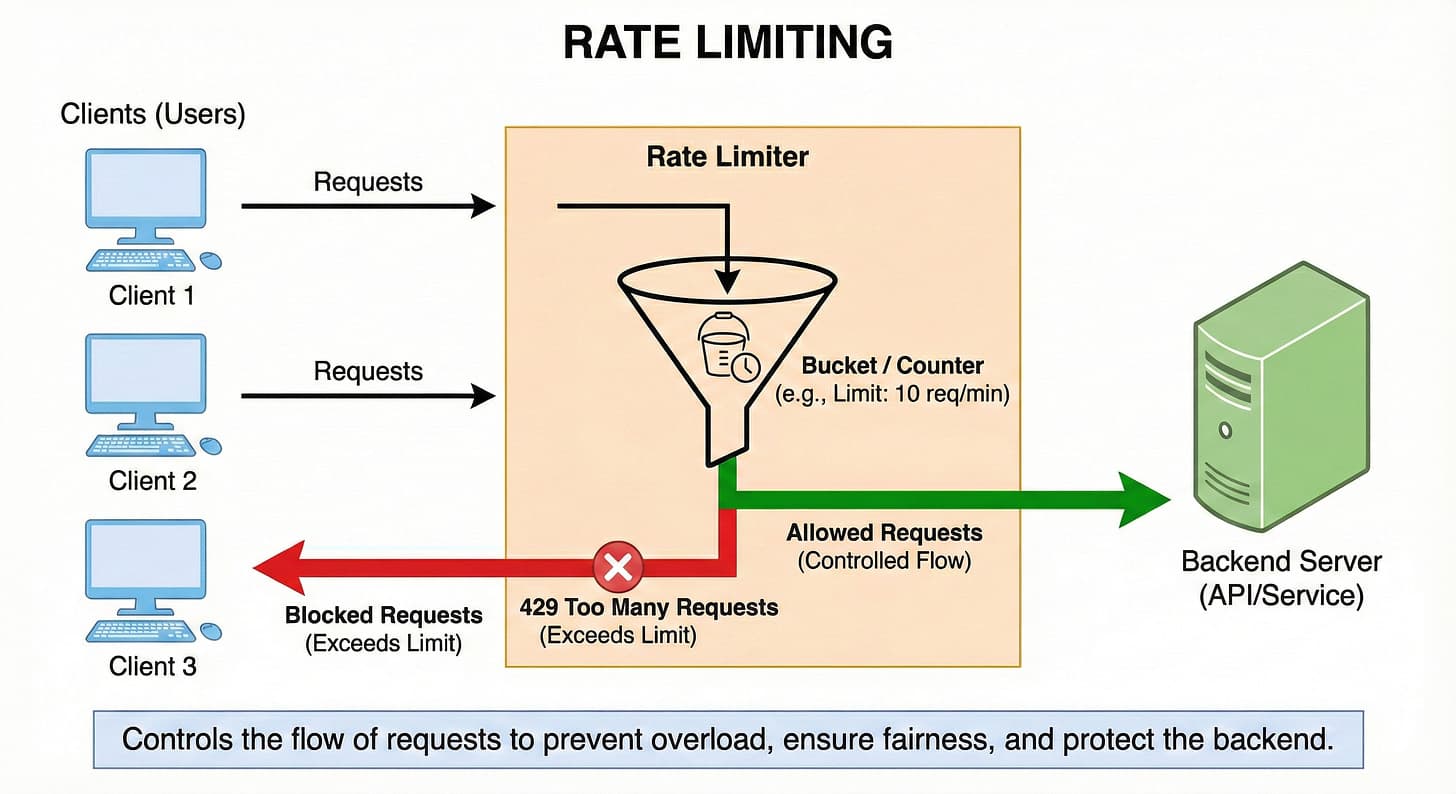
Rate limiting is a technique used to control the number of requests a user, IP, or API key can make within a given time window. It is an essential safety mechanism that prevents shared resources from being overwhelmed, ensuring system stability and reliability.
Common rate limiting strategies include:
- Fixed Window: Divides time into fixed intervals and allows a set number of requests within each interval.
- Sliding Window: Uses a moving time window to track requests more accurately and smoothly.
- Token Bucket: Stores tokens representing requests and refills them at a fixed rate, allowing controlled bursts of traffic.
Core Concepts
- Request: A single interaction with the system, such as an API call or web request.
- Time Window: The duration during which request counts are evaluated.
- Rate Limit: The maximum number of allowed requests within a time window.
- Burstiness: The system’s ability to tolerate temporary traffic spikes without rejecting requests unnecessarily.
Architecture Deep Dive
A typical rate limiting system includes the following components:
- API Gateway: Receives incoming requests and enforces rate limits.
- Load Balancer: Distributes traffic across multiple backend servers.
- Cache: Stores counters and temporary state for fast lookups.
- Database: Persists rate limit configurations and long-term metadata.
Distributed Systems Considerations
In distributed environments, rate limiting introduces additional challenges:
- Consistency: Applying limits uniformly across all nodes.
- Availability: Maintaining rate limiting functionality during failures.
- Partition Tolerance: Continuing operation during network splits or connectivity issues.
How Rate Limiting Works
- Request Receipt: The API gateway receives a request and checks the applicable rate limit policy.
- Counter Validation: The system verifies whether the request exceeds the allowed threshold.
- Counter Update: If allowed, the request counter is incremented.
- Cache Synchronization: Updated counters are written to cache for fast access.
- Database Persistence: State is periodically synchronized to durable storage.
Implementation Guide
Implementing rate limiting requires balancing performance, correctness, and operational complexity.
Token Bucket Algorithm
This implementation uses the token bucket algorithm to regulate incoming requests. Tokens are replenished over time, allowing short bursts while maintaining an overall request rate.
Performance and Scalability
Rate limiting can significantly impact system performance if implemented poorly.
Key considerations include:
- Cache Performance: In-memory stores such as Redis reduce database pressure and improve latency.
- Database Bottlenecks: Writing counters directly to persistent storage on every request does not scale well.
- Horizontal Scalability: Distributed rate limiting systems should support adding nodes without major reconfiguration.
- Low-Latency Enforcement: Rate checks should happen as close to the edge as possible to minimize request overhead.
Security and Reliability
Rate limiting is a critical defensive mechanism against abuse and denial-of-service attacks.
Important considerations:
- Authentication: Associate limits with authenticated identities when possible.
- Authorization: Apply different rate limits based on user roles or API tiers.
- Fault Tolerance: Ensure the limiter continues functioning during partial outages.
- Graceful Degradation: Fail safely under overload conditions instead of causing cascading failures.
Common Pitfalls
- Inconsistent Enforcement: Different nodes applying different counters or policies.
- Ignoring Burst Traffic: Overly strict limits that block legitimate spikes.
- Lack of Monitoring: Missing visibility into rejected requests and traffic patterns.
- Global Locks: Poor synchronization strategies that reduce throughput.
- Single Point of Failure: Centralized rate limit stores without redundancy.
Real-World Use Cases
- API Protection: Preventing abuse of public and private APIs.
- Web Application Defense: Mitigating brute-force and denial-of-service attacks.
- Multi-Tenant Systems: Ensuring fair resource usage across customers.
- Infrastructure Protection: Limiting traffic at CDN, edge, or gateway layers.
Future Trends
- Machine Learning-Based Rate Limiting: Adaptive systems that detect anomalous traffic patterns dynamically.
- Cloud-Native Enforcement: Deep integration with Kubernetes, service meshes, and API gateways.
- Edge Rate Limiting: Performing enforcement closer to users to reduce latency.
- Behavior-Aware Policies: Combining user behavior, reputation, and request context for smarter throttling.
Key Takeaways
- Rate limiting protects systems from abuse, overload, and resource exhaustion.
- Different algorithms provide different trade-offs between simplicity, fairness, and burst handling.
- Distributed systems require careful coordination to maintain consistent enforcement.
- Caching and edge enforcement are critical for performance at scale.
- Observability and monitoring are essential for tuning and maintaining effective limits.
- Emerging approaches are making rate limiting more adaptive, scalable, and intelligent.